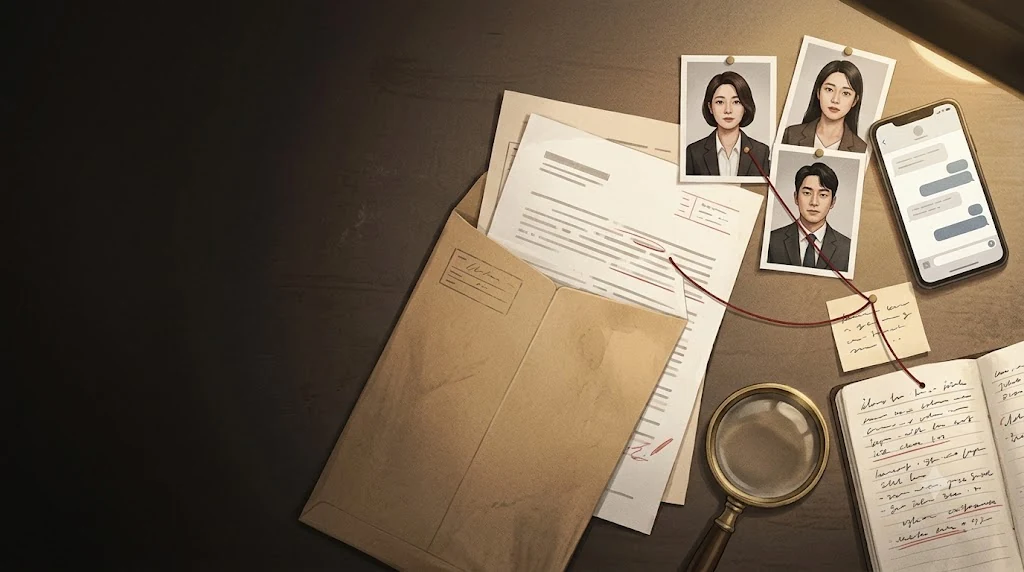
YOUR FIRST ASSIGNMENT AWAITS
A little Korean.
A lot of mystery.
You’re the detective. The clues are in Korean.
Uncover a word, question an alibi, and piece together the case—one small discovery at a time.
FREE TO PLAY · NO SIGN-UP · ENGLISH STORY
YOUR FIRST CLUE · A SMALL DISCOVERY
Two endings.
A question worth asking.
Try the highlighted words in this message. You don’t need to know Korean to notice a change.
An example from Case 1. The language gives you a lead; the rest of the evidence helps you test it.
Select 가요 or 기다려 to uncover its meaning.
 CASE 001
OPEN FILE
START YOUR INVESTIGATION
The Red-Stained Script
빨간 대본
A K-drama director is found dead in his locked office. A note on his laptop seems to explain everything. Your linguistics partner isn’t convinced.
Advanced deduction, with Korean word explanations and an English-speaking partner.
Begin Case 1 ↗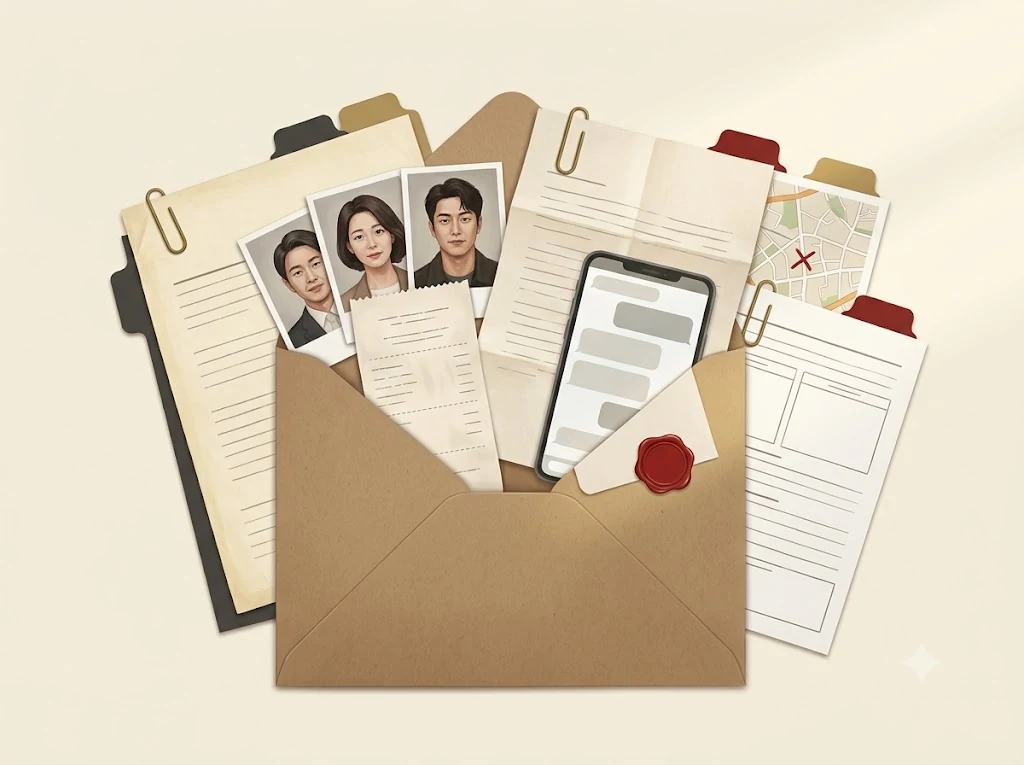 YOUR INVESTIGATION, ONE PIECE AT A TIME
HOW IT WORKS
Open the file.
Follow the Korean.
- 01
Meet the suspects
Read the briefing in English. Get to know the people, their stories, and what is at stake.
- 02
Learn a little. Notice more.
Examine short Korean clues. Click words, collect vocabulary, and ask your partner for context.
- 03
Make your case
Compare the language with the alibis. Choose a suspect and the evidence behind your deduction.
Play online today. Printable evidence kits are planned for a later release.
THE CASE FILES
Pick your next mystery.
The Red-Stained Script
빨간 대본
A director’s locked office. A suspicious note. Start with the words everyone else overlooked.
Open case file →The Diplomat’s Cipher
외교관의 암호
A locked embassy and a recording with a detail that does not belong.
Open case file →The Forged Will
위조된 유언장
A rewritten will. A family full of motives. Examine the choice of words.
Open case file →Dead Air
심야 방송
A radio host dies live on air. Listen closely to the suspects’ accounts.
Open case file →The Vanishing Point
소실점
A gallery director is dead. Someone’s account deserves a second look.
Open case file →The Cold Hearth
꺼진 아궁이
A snowbound hanok, four guests, and a message that challenges an alibi.
Open case file →A LITTLE PRACTICE GOES A LONG WAY
Build your detective vocabulary.
Meet the Korean alphabet
A first introduction to reading the words in your case files.
Learn Hangul →요 ↔ 반말RELATIONSHIPS IN LANGUAGEPolite or casual?
See how endings can change the way a message feels.
Explore speech levels →하나 · 일READ THE DETAILSNumbers that tell a story
Get to know the two number systems used in Korean.
Explore Korean numbers →For people who would rather
follow a clue.
Created by Payal Jarviya, Korean Whodunit brings language learning into original fictional mysteries. The idea and creative direction are human; AI tools helped bring the website to life.
Meet the project →BEFORE YOU OPEN THE FILE
A few questions,
answered.
Do I need to know Korean?
The story and interface are in English, with explanations for Korean evidence. If Hangul is new to you, start with the alphabet tutorial. The full cases involve challenging deductions; take your time and use your partner’s explanations.
How long does a case take?
The full cases are listed at about 45–90 minutes, depending on the case and your pace. You can learn a few words at a time. Your vocabulary notebook is stored in this browser; clearing browser data can remove it.
Is everything free?
Yes. All six current cases and the learning guides are free, with no account or payment required. The site is supported by advertising on learning guides.
How does the Korean help solve the mystery?
You read messages, compare statements, and look closely at wording. Language gives you questions to investigate alongside the story’s other evidence. Real speech is flexible: a grammar form alone does not prove guilt.
Can I download a printable case kit?
Printable evidence kits are planned, but are not available yet. You can play the current cases in your browser.
Who created Korean Whodunit?
Payal Jarviya created the concept and creative direction, using AI tools to help build the website. Feedback and Korean-language corrections are welcome through the contact page.
Already played? Leave a case debrief
How did your investigation go?
Every debrief makes the next case sharper. Tell us what hooked you, what confused you, or which suspect fooled you.